
Blog
Automating Facility Turf Care
Back to Blog(s)
December 17 2025
December 17 2025
Transforming Large-Scale Green Space Management With Robots
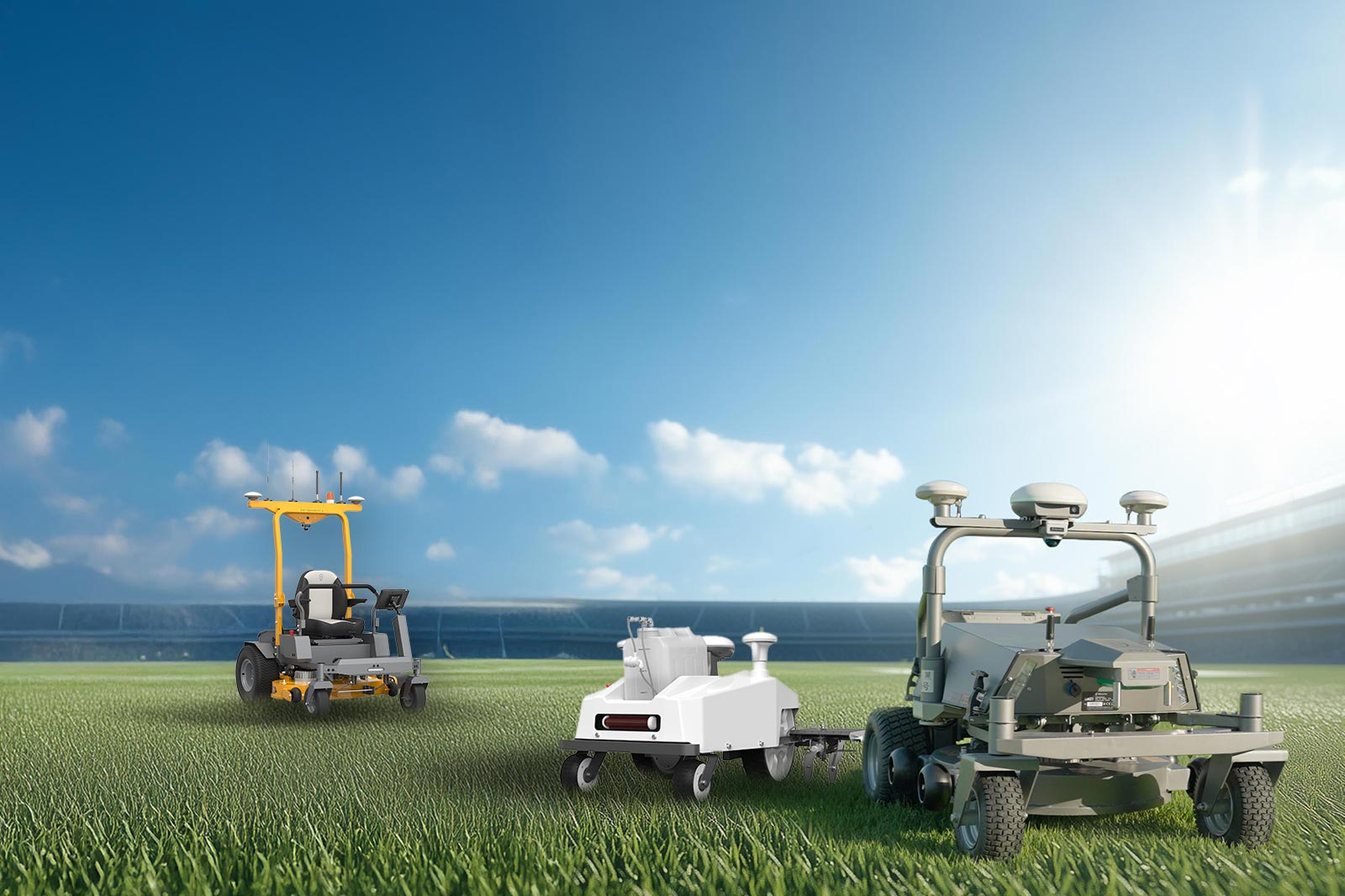
For decades, maintaining large expanses of turf—athletic fields, municipal parks, sprawling campuses, golf courses, and corporate grounds—has required significant labor, fuel, and equipment investment. Now that model is beginning to shift. Automation has already reshaped indoor facilities maintenance, and now it’s rapidly gaining traction in outdoor turf management.
Commercial-grade robotic turf care solutions are entering the market with the promise of safer operations, lower long-term costs, greater precision, and a dramatic reduction in staff workload. And unlike early-generation robotic mowers, today’s professional units are powerful, intelligent, and built for complex commercial environments—not just residential lawns.
Let’s explore why automated turf care is emerging now, what today’s robots can do, and how facilities teams can benefit from the latest generation of self-managing machines.
Why Automation Ideal for Turf Care
Several industry pressures are accelerating the move toward robotic groundskeeping:
Labor shortages in outdoor maintenance
Parks departments, athletic facilities, and campus operations teams across the U.S. report ongoing challenges hiring and retaining qualified groundskeepers. Mowing is highly repetitive, time consuming, and can be difficult to staff consistently. Automation frees existing personnel to focus on higher-value landscaping and facility tasks.
Increasing sustainability benchmarks
Many municipalities, schools, and corporations are pushing to reduce emissions and transition away from gas-powered maintenance equipment. Today’s autonomous turf-care robots are fully electric, extremely quiet, and dramatically more energy-efficient than traditional mowers.
Rising expectations for field and turf quality
Sports programs demand perfectly lined fields. Campuses expect precisely cut and consistent green spaces. Municipalities must maintain vast areas with limited budgets. Robots deliver repeatable, uniform results—no fatigue, no human error, and no deviations from course.
What Modern Turf Care Robots Can Do
Autonomous commercial mowing robots have advanced far beyond simple residential “random-path” mowers. Solutions offered by Pringle Robotics integrate AI navigation, cloud-based mapping, and longlife battery power to deliver commercial-grade performance.
Here’s what’s possible today:
Autonomous mowing with professional precision
Facilities with golf courses, office parks, corporate grounds, municipal spaces, and athletic fields can increasingly rely on this new generation of commercial-grade robot mowers to handle regular maintenance.
Robots like the Z42P work as both fully autonomous and manually operated units, giving teams flexibility. It uses AI-enhanced path planning and LiDAR, allowing it to operate even in environments where traditional RTK GPS signals are weak—such as under trees, near structures, or on varied terrain. These units are designed for unmanned, professional-grade mowing across broad, complex outdoor areas.
For larger turf operations, models like the RM21 enable a new level of commercial-grade robotic mowing with:
- Fully autonomous operation able to tackle complex terrain
- Cloud-based mapping
- Reliable centimeter-level precision and the ability to mow long or wet grass
- Ability to climb inclines up to 20°
- Automated charging
- 360° obstacle detection and avoidance
Together, these capabilities allow the robot to maintain consistent mowing results day after day—without manual supervision.
Automated line marking for athletic facilities
For athletic fields—and the schools, parks and recreation departments, and municipalities who oversee them—precision line marking is a major effort. It can take teams of multiple people days to complete, needs to be repeated regularly, and can be hampered by rain. Robotic line markers eliminate those challenges entirely.
The RLM01 PaintMaster Pro can autonomously complete in a few hours what would take days to complete manually. It brings centimeter-level accuracy to line marking, leveraging dual GNSS systems and a local base station to ensure perfect field lines every time. With an optional laser marking kit, millimeter accuracy is possible even in areas where GPS is partially obstructed. Its vision system enables all-weather and nighttime operation, while its lightweight design means staff can set up a field with minimal physical strain.
This is a game-changer for:
- High schools and colleges
- Professional training facilities
- Parks and rec departments
- Community sports complexes
A time-consuming and labor-intensive job becomes an automated, precisely repeatable task.
Why Organizations Should Consider Automating Now
Many organizations are adopting automated turf-care equipment not just for labor relief but for broader operational gains. Key benefits include:
Greater scheduling flexibility
Robots can mow early in the morning, at night, or during low-traffic hours without disturbing staff or other users of the space.
Improved safety
Autonomous units eliminate many risks tied to traditional mowing, including debris projection, operator fatigue, or mishandling of heavy equipment. In-built safety mechanisms, such as 360° object detection and avoidance, collision bumpers, anti-lift protection, and rain monitoring ensure accident-free mowing.
Lower long-term costs
Electric operation reduces fuel expenses, and consistent robotic mowing minimizes turf stress, often improving turf health and reducing maintenance needs over time.
Scalability across expansive grounds
Once deployed, robots can operate simultaneously across multiple fields or zones, drastically cutting down time spent mowing, and allowing landscaping staff to focus on other important tasks.
Is Automated Turf Care Right for Your Facility?
If your organization maintains large green spaces—or struggles with labor/time shortages, budget constraints, or demanding turf-quality standards—robotic turf care may be a natural next step.
Facilities seeing the fastest ROI typically include:
- Municipal parks and recreation departments
- Golf courses and driving ranges
- School districts and college campuses
- Athletic facilities and sports complexes
- Corporate and healthcare campuses
- Large commercial or industrial grounds
Not Just for Backyards Anymore
Homeowners have enjoyed the growing popularity and availability of robot lawn mowers for several years now. Unfortunately, most options marketed for commercial use have, until recently, been virtually the same as residential models, and not up to the demands of maintaining extensive areas of grass.
Now, with purpose-built commercial-grade robots designed for precision mowing on complex terrain, enabled with LiDAR and AI-driven navigation, automated charging, and even capable of high-accuracy athletic field lining, facilities teams finally have the tools to automate the maintenance of vast outdoor areas.
If automating turf care is a step you’re considering, our team is here to help. Get in touch today to get started!

Leave a comment below...